Olive Oil
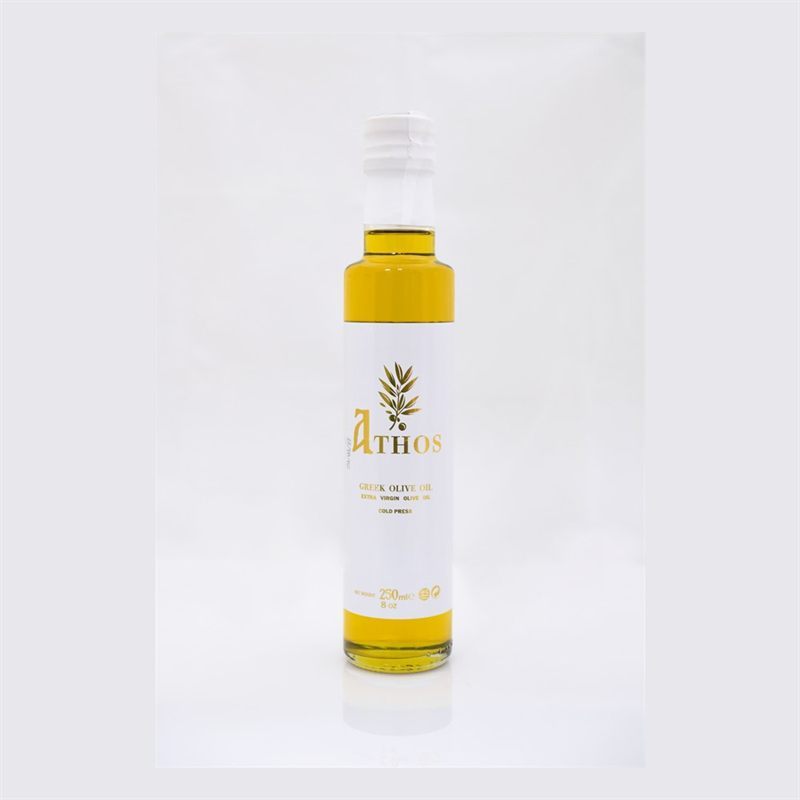
ATHOS Extra Virgin Olive Oil
Five formats · from 100 ml to 4 L
One variety, Agioreitiki, harvested in Halkidiki and cold pressed at Ormilia in northern Greece — no heat, no solvents, so the aroma reaches the bottle intact. The figures say the rest: acidity 0.41%, close to half the 0.8% limit below which an oil may call itself extra virgin. Peroxide value 8.1 out of a permitted 20. Eight pesticides tested for in the laboratory, none detected. Official tasting panel: fruity 3.8, bitter 2.4, pungent 3.3 — and zero defects. The bitterness and the catch at the back of the throat are not mistakes but polyphenols; an oil that tastes of nothing at all is almost always a refined one. Olive oil has sat at the centre of the Mediterranean diet for thousands of years for a simple reason: it is a natural food, made from a single fruit, that you use every day.
Out of stock
Was
How to use it
Keep it for raw use: over a Greek salad, over white beans, over a thick soup just before serving. Heat destroys exactly the aromas you are paying for in an extra virgin oil.
Frequently asked questions
What does acidity mean in an olive oil?
Free acidity is not something you taste, and it has nothing to do with sourness — it measures how well the olives were handled between tree and press. The longer the fruit waits, bruises or warms up, the more fatty acids break down and the higher the figure climbs. European rules allow a maximum of 0.8% for an extra virgin oil; above that it loses the name, however well it was made. Ours is 0.41%, roughly half the limit.
Does olive oil help maintain normal cholesterol?
Replacing saturated fats with unsaturated fats in the diet contributes to the maintenance of normal blood cholesterol levels. Oleic acid is an unsaturated fat. Our oil qualifies: of 91.6 g of fat per 100 ml, 78 g are unsaturated, 71.7 g of them monounsaturated. The effect comes from replacing saturated fat with it, not from adding it on top of what you already eat. If you are under treatment or have a condition, speak to your doctor — we sell food, not remedies.
Why use olive oil instead of butter?
Because of the ratio between fats. Per 100 ml our oil has 13.6 g of saturated fat and 78 g unsaturated — butter is roughly the other way round. That swap is exactly what the authorised statement above refers to: you are not adding oil on top of what you eat, you are putting it in place of a saturated fat. In practice that means oil in the pan instead of butter, oil over vegetables instead of cream, oil in the dough where the recipe allows.
Is olive oil fattening?
Olive oil is 824 kcal per 100 ml — like any fat, it is energy dense. But nobody drinks 100 ml: a tablespoon is about 12 ml, so roughly 100 kcal, and a salad for four takes two or three. What matters is what it replaces. Used instead of butter, margarine or a ready-made dressing, it changes the kind of fat on the plate without adding much to the total. Poured over an already rich meal, it simply adds up.
Why is it bitter and peppery in the throat?
Because it is fresh and unrefined. The bitterness and pepperiness come from polyphenols, the natural compounds in the olive fruit that refining strips out. The official tasting panel scored bitter 2.4 and pungent 3.3 out of 10, with fruitiness at 3.8 and zero defects — present and balanced, without covering the fruit. An oil that tastes of nothing at all is almost always a refined one.
Can I cook with it, or does heat ruin it?
You can cook with it quite safely. Extra virgin olive oil smokes at around 190–210°C, above the temperature at which you roast vegetables, sauté or sweat onions. What makes no sense is repeated deep frying, or pouring it into an empty pan left until it smokes — that is where you lose exactly what you paid for. For the most flavour, keep some back to finish the dish raw.
How do I store it?
Cool, dark, and tightly closed. Light is the main enemy of a good oil, more than time — which is why the large formats come in metal tins. Do not keep it beside the hob or on a windowsill. If you have the 4-litre tin, refill a small bottle from it for the kitchen and leave the rest shut in the pantry.